
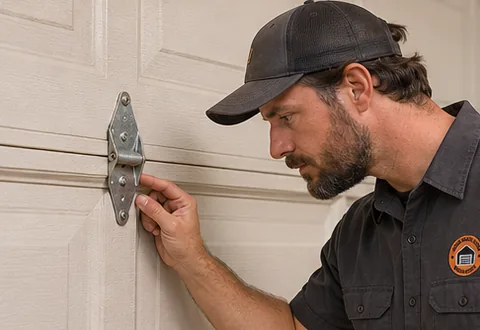
Look for changes across ordinary use
The door can seem normal one day and start scraping or hesitating the next. Other clues include steady vibration near the top of travel, daylight that has appeared around a previously sealed edge, or a remote that has become unreliable. Wind-driven rain, road salt near the entrance, and everyday use can all leave visible wear around the lower edges and hardware.
A homeowner searching garage door repair near me may have noticed a symptom that does not fit neatly into a single part. Tell us when it appeared and whether it has become more frequent. A comparison with how the door used to sound or move is helpful even when it has never stopped working.
What happens during a maintenance visit
The technician checks visible hardware, door travel, tracks, rollers, and sealing surfaces. On an automatic door, the opener and its safety features are also considered. We look at how the door moves through its whole travel, because a quiet start can still be followed by hesitation at the curve or inconsistent contact at the floor.
Where wear is isolated, the findings can help you plan the next service. If the door is heavy or refuses to stay level, that points toward a mechanical inspection. Read about spring problems or roller and hinge wear for examples of the symptoms tied to those components.
Plan around the way you use the garage
A garage that serves as the main entrance sees more cycles than a storage garage. Seasonal dampness around a detached door or a sloped driveway can change what you notice at the threshold. If you are arranging garage door repair in Jersey City, NJ, mention frequent use, previous repairs, and any recent change to the floor or opening.
If you found us while looking for a garage door repair service near me before buying a home or after moving in, share which features are unfamiliar. Knowing whether the door is manual, when the opener was added, or which remote came with the house helps us tailor the visit.